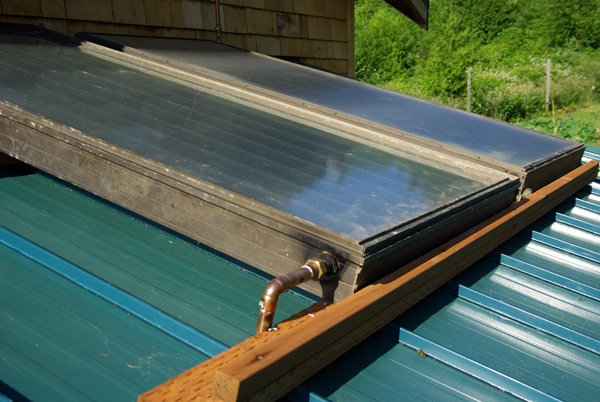
Solar hot water at Revolution Gardens. This do-it-yourself installation utilizing recycled panels and storage tank was built
in 12 hours for about $300, it produces 50 gallons of 170 degree water on a sunny day with an expected lifespan 10-15 years.
note: this class has been moved from August to September.
Solar hot water September 13-14th Cost $75 per day
Working in conjunction with local solar architect Anthony Stoppiello and guest speaker John Patterson from Mr. Sun Solar, Revolution Gardens is offering a two day introduction to solar water heating technology. On day one of this class Anthony will present a history of solar hot water, and explain system types and their advantages, as well as costs and considerations for our climate. Anthony will guide the class in a solar site evaluation, teaching how to assess solar potential. John Patterson will give a tour of a typical commercial system installed by Mr. Sun at Anthonys' house, a mile from Revolution Garden. John will explain in detail the cost advantages, substantial tax incentives, and utility rebates available for commercially installed systems. Students will leave this class with a comprehensive understanding of solar water heating technology. By presenting a full spectrum of information, taught by experts, we insure that you'll have the specific resources to make smart choices when deciding to install your own system. This is the perfect primer for anyone considering adding solar hot water to their home.
On day two of the class we get our hands dirty and dive into the construction of a do-it-yourself hot water heater. From mostly recycled materials we will build a working solar hot water heater similar to the ones used across America at the turn of the century. Building the water heater teaches important plumbing skills and instills the principles learned in the class. We will show you how to safely penetrate the house without causing leaks, and how to tie into your existing water heating system safely. Brian Schulz will show and explain the Revolution Garden solar hot water system.
STUDENTS ARE WELCOME TO ONLY TAKE ONE DAY OF THE CLASS. This makes things a bit cheaper if you're on a budget. For those who might head toward a commercial system, day one will give you a comprehensive overview. For those who like to build things on the cheap, day two will get you there. Both days, however, will give you a more complete understanding of the technology.
The class lasts 9am-5pm Saturday and Sunday. Lunch prepared with fresh organic food from our garden is provided Saturday and Sunday, and a potluck dinner and barbeque will be held on the land Saturday night. Students are welcome to camp on the the land for free and we are happy to help arrange local accommodations.
Instructors:
Brian Schulz teaches wooden boat building for a living, he is carpenter, and an avid do-it-yourself alternative technology experimenter. He specializes in distilling complex information into a fun, easy to follow format. Brian designed and built all of the alternative energy systems at the energy independant Revolution Garden homestead. His energetic teaching style communicates an infectious enthusiasm.
Licensed in Oregon and Washington, Anthony Stoppiello has over 35 years architecture experience, emphasizing solar, healthy and environmentally preferable materials, with maximum natural light and energy efficiency. He provides architecture design, consulting, talks and hands-on workshops covering solar energy, site evaluation, and remodeling utilizing permaculture principles. http://www.stoppielloarchitecture.com
John Patterson is the owner of Mr Sun Solar. Since 1980 Mr. Sun has sold and serviced thousands of solar energy systems. What started as John's one-man operation has grown to a team of over 20 employees and subcontractors. Our experience is unparalleled in the industry. In addition to servicing and installing solar products, Mr. Sun strives to further solar energy causes and awareness through educational outreach and active involvement in energy policy legislation. http://www.mrsunsolar.com/
To Register for this class contact Ginger at fairtradediva@yahoo.com or call 503 368 3044
Oregon coast homesteaders install do-it-yourself solar hot water. by Brian Schulz
Five minutes ago will mark the approximately one hundredth time in the last two weeks I’ve reported the progress of our newly installed solar hot water heating system. Every day, sometimes every ten minutes of every day, I run upstairs to see the thermometer on the storage tank slowly rising. “Ginger!” I yell out the window. “What?” she replies from the gardens below. “The water is one hundred twenty degrees!” I exclaim with amazement, as though this were the very first time I’d seen it. This scene will replay itself a half dozen more times today with the only differences being the height of the sun and number on the gauge. Our water heater, normally the largest single energy consumer in a household, is running for free.
In many ways our solar hot water system couldn’t be worse. The installation rests on a rack of recycled pressure treated lumber, screwed, rather crudely, into the less than ideal angle of my 3/12 pitch, south facing, porch roof. In the rack rests two flat plate collectors: narrow insulated boxes filled with copper piping and covered with special glass. Built in the 1970’s, these old collectors have seen better days; the insulation is outdated, the air seals are disintegrating, the fasteners are corroded, and the special glass on one of them is facing the wrong way. Fortunately the copper piping is healthy and intact. From the collectors I’ve routed copper piping to a used water heater sitting behind an adjacent wall and hot water flows naturally in and out of the tank via the phenomenon of hot liquid rising all by itself. My piping is uninsulated, meaning than a considerable portion of the heat harvested from the sun is lost on its’ way to the storage tank. I also have only two-thirds of the collector area recommended for this climate.
I slapped this quick and dirty system together for a few hundred dollars in two afternoons, and despite my best efforts to make it as inefficient as possible, by three o’clock this afternoon I will be yelling out the window, “…one hundred seventy degrees!” a temperature on par with modern systems of similar design. I will be eliminating the losses in my system as fall approaches, but for now this minimalist do-it-yourself installation often produces too much hot water. I needed to install a tempering valve to safeguard against scalding temperatures at the tap.
After our first luxuriously hot solar heated showers, Gin and I looked at each other and posed the obvious question, why doesn’t everyone have one of these? One answer is that everyone used to. Across America in the early 20th century, simple solar water heaters were common although their use dwindled with the introduction of cheap electricity and gas. Again in the 1970’s, as energy prices spiked, solar technology came into vogue and things were headed in a good direction until President Reagan deregulated the energy industry, killed tax incentives for renewables, and ripped the solar water heating panels off the roof of the White House. The message was that energy scarcity was a thing of the past and that the eighties were going to be just like the fifties, prosperous and unlimited. Twenty years later we are back at this same junction except this time with three billion more people on the planet, and carbon dioxide levels on the atmosphere dangerously elevated. Now that president Bushs’ massive tax breaks and deregulation attempts have failed to stimulate economic growth, nobody believes that the 2000’s are going to be just like the fifties. Once again America is poised to take solar seriously. We face a future where solar is not only the smartest option for harvesting heat, but also the cheapest.
Cheap compared to what though? It’s easy for those with a retirement savings to talk about payout times and efficiency curves. Unfortunately, an increasing number of us can barely pay the bills each month. This is where do-it-yourself solar water has a lot to offer. For very little money you can build a simple, efficient solar hot water heater. Unlike a solar electric panel, which is a bit beyond the capabilities of the average home builder, a solar water heater is a simple construction that lends itself to recycled materials and once you understand a few basic principles you will start seeing possibilities in every piece of scrap you look at. Of course tinkering with junk water heaters and scraps of pipe is not everyone’s idea of a good time and for those who can still call themselves middle class a commercial system will provide excellent reliability and efficiency. Substantial tax incentives and rebates can bring the cost of a professionally installed system down to four thousand dollars or less.
But does solar really make sense when you live in a rain forest? It’s true that a solar water heater won’t work all the time on the north coast, but any time there is sun or light cloud cover it works surprisingly well. If you could run your water heater for free half the year wouldn’t you? Solar hot water isn’t an all or nothing proposition and most systems are installed as preheaters in-line with existing electric or gas hot water. In the summer the solar does most of the work, in the spring and fall part of it, and in the winter, just some of the work. On the Oregon coast a solar water heater will typically pick up 50-60% of the overall heating load. A typical solar water heater will pay for itself in less than ten years, providing free hot water for the rest of its’ forty year lifespan, yielding a net saving of fifty to a hundred thousand dollars. That’s a lot of money.
There is also the issue of reliability whenever solar is discussed. Again the concern arises from the misconception that renewable energy needs to operate independently from the “reliable” local utility. Whereas comfortable off-the-grid systems are possible, most people choose to supplement with utility power, and the fear of lukewarm showers is largely unfounded. Reliability is also relative concept, and with utility power more vulnerable than ever due to extreme weather and extreme demand, solar hot water and electric systems are looking better and better.
For registration and information contact Ginger 503 368 3044 fairtradediva@yahoo.com
Back to Revolution Gardens home